An option. Tenancies belongs to letting management, which an organisation switches on under Settings, Organisation. Without it the page is not there at all, and the door phone underneath carries on as normal.
Tenancies, rent and deposits
Signing somebody up gives them the door. A tenancy is the agreement behind it: the term, the rent, the deposit and the papers a landlord has to serve. Starting one on Tenancies does both at once, so nobody ends up with a tenancy and no way through their own front door.
Where it lives
Tenancies sits under Properties in the sidebar, with Turnovers, Rates and the Calendar. Rates is for letting a property out on a price card, by the night, the week or the month; Tenancies is the agreement with somebody who lives there. A property can be used either way, but not at the same time: a property with a tenancy running is not offered to short stays.
Starting one
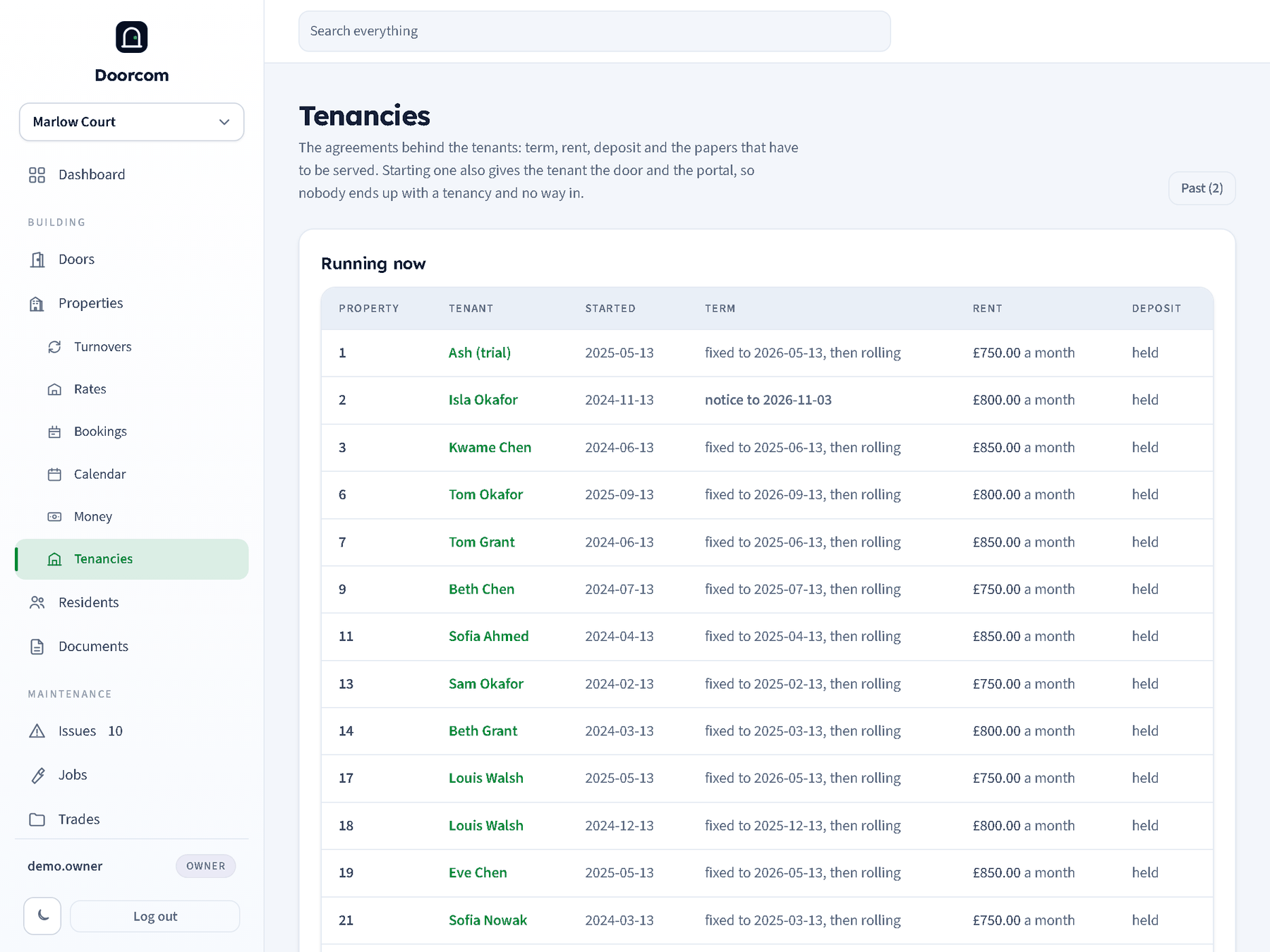
The top of the page lists what is running now: property, tenant, start date, term, rent and whether a deposit is held. Past in the corner shows the ones that have ended, with the reason. Below is the start form.
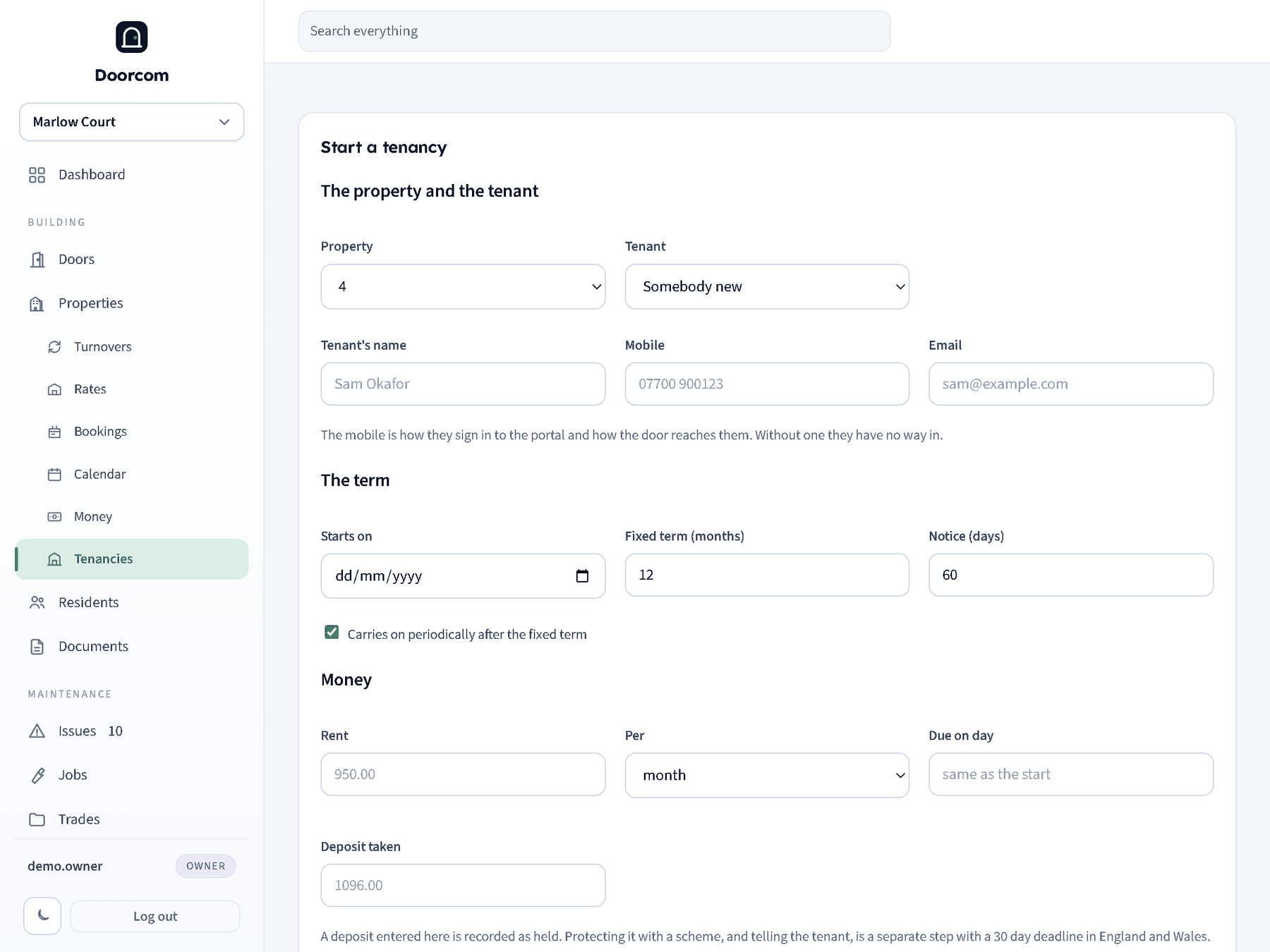
- The property and the tenant
- Only properties with no tenancy running are offered. Tenant is either somebody already on the books or Somebody new, in which case their name, mobile and email are typed here. The mobile is how they sign in to the resident portal and how the door reaches them, so a tenancy without one leaves them no way in. An email is enough on its own if they would rather not give a number, but then the door cannot ring them.
- The term
- Starts on can be in the past, which is how an existing tenant is brought across. Fixed term (months) works out the date the fixed term ends; zero means there is no fixed term. Carries on periodically after the fixed term is the usual arrangement in England and Wales. Notice (days) is recorded for reference; Doorcom does not serve notices.
- Money
- Where the rent comes from, which depends on the property — see below. Due on day is the day of the month (or 1 to 7 for a weekly tenancy) the rent has to be with you; leave it blank to use the day the tenancy starts. Deposit taken records the money as held.
Choosing a property that somebody already lives in names them as the tenant, because that is nearly always who it is: a tenant who claimed the property from the poster before anybody wrote the agreement down should not end up with a second record. The list also holds everybody else in the building and everybody who has moved out. Naming somebody who lives in another property moves them to this one; naming somebody who moved out brings them back. Either way their record, their Telegram link and their history come with them.
Starting the tenancy creates the tenant as a resident of that property, so the poster, the bell and the portal work for them straight away, and writes the agreement and the deposit. The change log records it. A property that already has a tenancy running is refused rather than let twice.
Letting the tenant fill their own details in
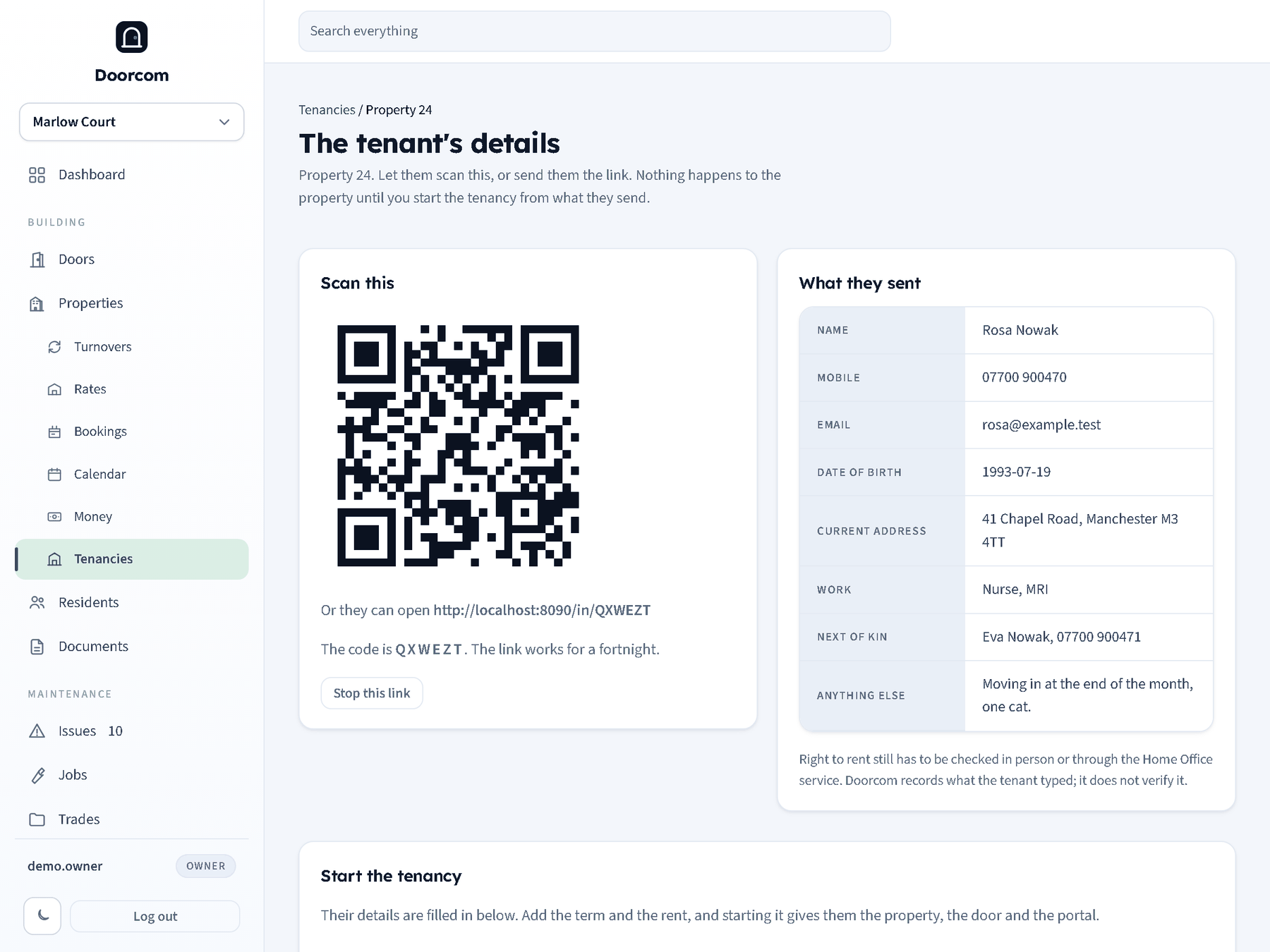
Typing somebody's name, number and next of kin off a scrap of paper is how the office ends up holding a wrong mobile for the person whose door it rings. On Tenancies, Make a QR for this property creates a link for one property: show the tenant the QR, or send them the link or the six character code. They open it on their own phone and fill in their name, mobile, email, date of birth, where they live now, what they do and who to call in an emergency.
Their answers come back to the same page. Nothing about the property changes until somebody in the office presses Start the tenancy, with the details already filled in, so a link that reaches the wrong person wastes a form rather than handing out a front door. The link lasts a fortnight, can be stopped at any time from its page, and stops working the moment a tenancy is started from it. Right to rent still has to be checked properly: Doorcom records what the tenant typed, it does not verify it.
The rent comes from the property
A property on a rate card is let at the card's price. Pick the property and the card's name appears next to it in the list, the Money section says which card the rent comes from, and Rate is a dropdown of the ways that card is sold: by the month, by the week, by the night. There is no rent box, because there is nothing to type.
A property on no card has the rent box as usual, with the same month, week or night dropdown beside it.
Let this one off rate brings the rent box back for a property that is on a card, for the let that is done at a different figure. The card's price is filled in as a starting point and can be changed, and a link puts the property back on the card price if the button was pressed by mistake.
The price is read from the card when the tenancy is written, not taken from the page, so a form left open while somebody changes a price cannot write the old one. Changing a card's price later does not change a tenancy that has already started: that rent is part of an agreement, and a rent rise is its own act.
A nightly tenancy invoices a night at a time, which is what it means. For a stay of a few nights, take a booking instead.
The tenancy page
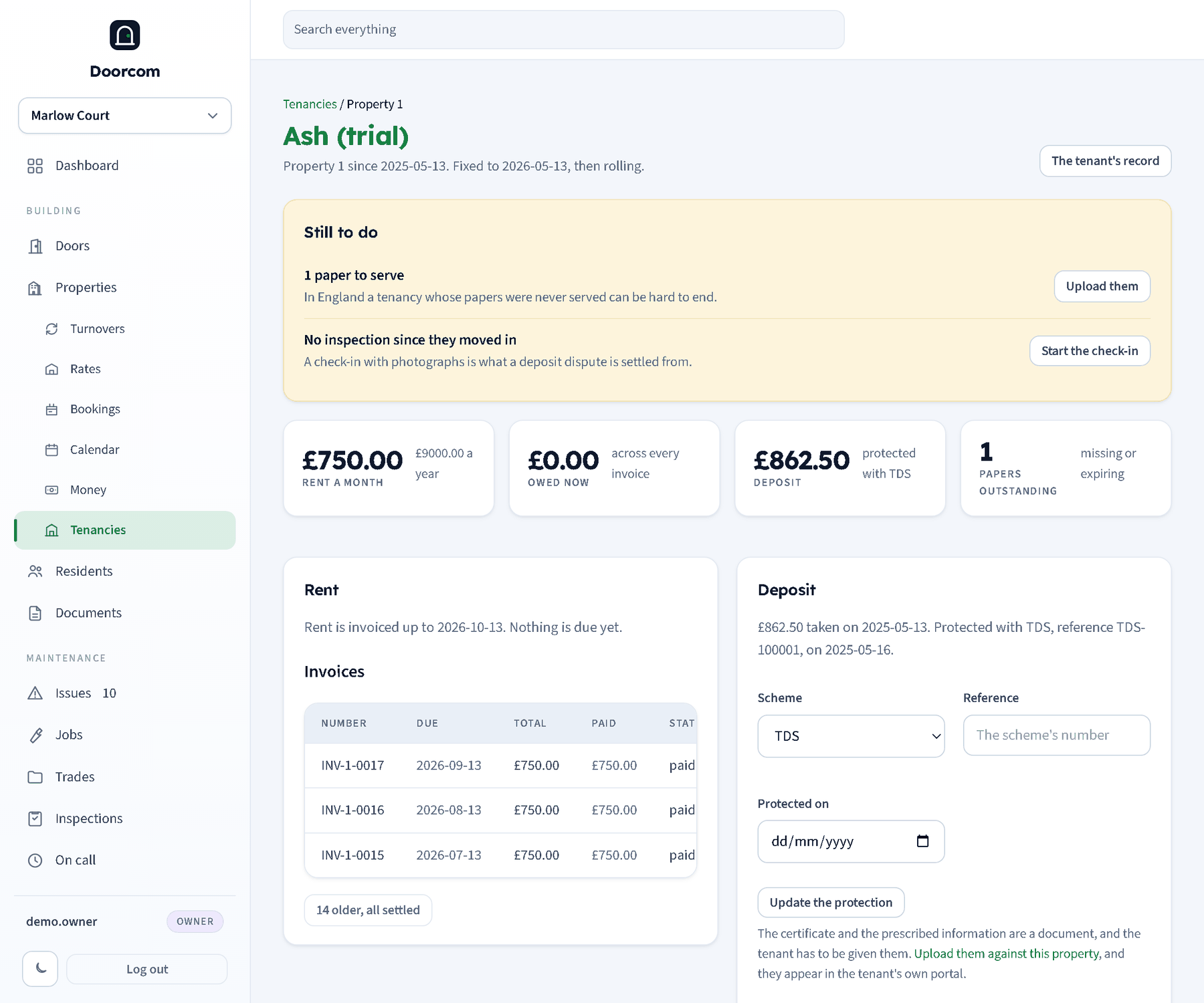
Still to do sits above everything else when there is anything in it: the deposit not yet protected, with the day the 30 days runs out and in red once it has; papers not served; rent periods that have started and not been invoiced; no inspection since the tenant moved in; and a tenancy still running on a property nobody lives in. Each line has the button that deals with it. When the list is empty the block is not drawn, which is the point of it.
Then four figures: the rent (and what that is a year, so a weekly tenancy can be compared with a monthly one), what the tenant owes across every invoice, the deposit and whether it is protected, and how many of the required papers for that property are missing or expiring.
Rent
Rent is invoiced one period at a time. A period counts as due the moment it starts, because rent is paid in advance. Any period that has started and has not been invoiced is listed with a Raise the rent invoice(s) button; pressing it writes one invoice per period and moves the marker, so pressing it twice does not invoice the same month again. Doorcom also does this by itself every hour, so a tenancy left alone keeps its own books.
Rent invoices go out as issued rather than sitting in drafts, and carry no VAT: residential rent is exempt. Short stays are different, and are invoiced with VAT at the standard rate.
The invoice table shows anything owing and the last three that are settled; a tenancy of two years folds the rest away behind older, all settled.
The check-in
Start the check-in in Still to do opens the building's check-in checklist for that property: the condition, the meters and the photographs, signed and dated, stored against the property where the tenant can see it too. It is the same thing a turnover does at the other end with the check-out, and it is what a deposit dispute is settled from eighteen months later. See Inspections and checklists.
Payments
Record a payment puts money against one of the tenant's invoices: the amount (leave it blank for the whole invoice), how it arrived, the date and a reference such as the bank line. The invoice moves to part paid or paid, and what is owed at the top comes down.
The deposit
A deposit arrives the way rent does, so it is recorded the same way: how it came — usually a bank transfer — and the reference to find it by on the statement. Both are on the start form next to the amount, and both are shown on the tenancy. Giving it back asks the same two questions, so the return can be matched to the statement as well.
The deposit taken at the start is recorded as held. Protecting it is a separate act: choose the scheme, put in its reference and the date, and Doorcom keeps it with the tenancy. In England and Wales a deposit has to be in an approved scheme, and the tenant given the prescribed information, within 30 days of taking it; the penalty for missing that falls on the landlord, which is why the field is next to the deposit rather than in a finance page. The certificate itself is a document: upload it against the property from Documents.
Taking something off it
After the check-out, Take something off it has a picker of the problems reported at that property since the tenancy began — which is where the check-out's fails end up. Choosing one fills in what it was for, and what the repair cost if somebody has written that down on the job. Both stay editable: the invoice is the figure, the deduction is what you are actually keeping.
The deduction keeps the link to the problem, so the tenant is not being shown a line of text but a report with photographs behind it. A deduction still has to be for a real loss, told to the tenant, and can be disputed through the scheme; it cannot come to more than the deposit.
What a repair cost is recorded on the issue, next to the job: What it cost, off the trade's invoice. It is the landlord's own figure. A trade marks a job done, never paid.
Papers
The paperwork for that property is listed with its state, taken from the same checklist as the Documents page. A tenancy whose papers were never served can be hard to end, so anything missing is worth clearing early.
Reviewing the rent
A review changes what is demanded from the next period on. Periods already invoiced stay as they were, which is what "from the 1st of April" means when rent is paid in advance. The old figure and the reason are kept in the tenancy's notes, so the history reads back. On a property with a rate card the new rent is picked from the card; on one without, it is typed.
Doorcom writes it down. Telling the tenant in the right form, with the notice the law asks for, is still the landlord's to do.
Notice
Notice records that somebody has given it: by the tenant or the landlord, the day it was given, and the day the tenancy runs to. Leave the leaving date blank and it is worked out from the notice period on the agreement.
Once notice is on a tenancy: the list shows it as notice to that date instead of its term, rent stops being invoiced past it, the dashboard counts it among what is ending in the next two months, and the end form is filled in with that date. A notice can be taken back.
This is a note in the record, not a notice served. A section 21 or a section 8 has its own form and its own rules, and getting those wrong is expensive.
What the tenant sees
The same facts from their side: the terms, the deposit and its scheme, what they owe, the invoices and how to pay. It is on their own portal under Your tenancy, described in The resident portal. Nothing there can be changed by the tenant, and a draft invoice stays out of it until it is raised.
Ending one
End this tenancy takes the date it ended and the reason. Ticking Move the tenant out too at the same time stops the door ringing them and frees the property; their record is archived rather than deleted, so the history stays. Rent stops at the end date even if invoicing is run later.
The deposit does not go back by itself when the tenancy ends, and that is on purpose: what is being kept is agreed after the check-out, not before. So the record stays held, in the tenant's name, against that tenancy — which is what a scheme dispute is argued from — until you take off the deductions and record the return. Until you do, it is marked on the Money page as held against a tenancy that has ended, and counted on the dashboard as a deposit to give back. What leaves with the tenant is the money.
You stay on the tenancy, at the deposit, because that is what is left to do: take off what you are keeping, then give the rest back. If the property is now empty a turnover opens at the same time, and the message says so.
The tenant, and everybody else in the property
A property can hold several people: a partner, a lodger, a grown-up child, a second name on the bell. They are all residents and the door rings them all. The agreement names one of them, and the Residents list marks that one tenant.
Moving the tenant out ends the tenancy, dated that day, whichever page you do it from — the resident's own page, the property, or the tenant leaving from their portal. It says so before you do it and again afterwards, and the deposit stays held until you give it back. Moving anybody else out changes nothing about the agreement; they simply stop being rung.
Ending the agreement and moving the tenant out are two acts, which is deliberate — a tenant can leave before the agreement ends, and an agreement can end with somebody still in the property. When they do come apart, Still to do says so rather than leaving a tenancy quietly running on an empty flat.